
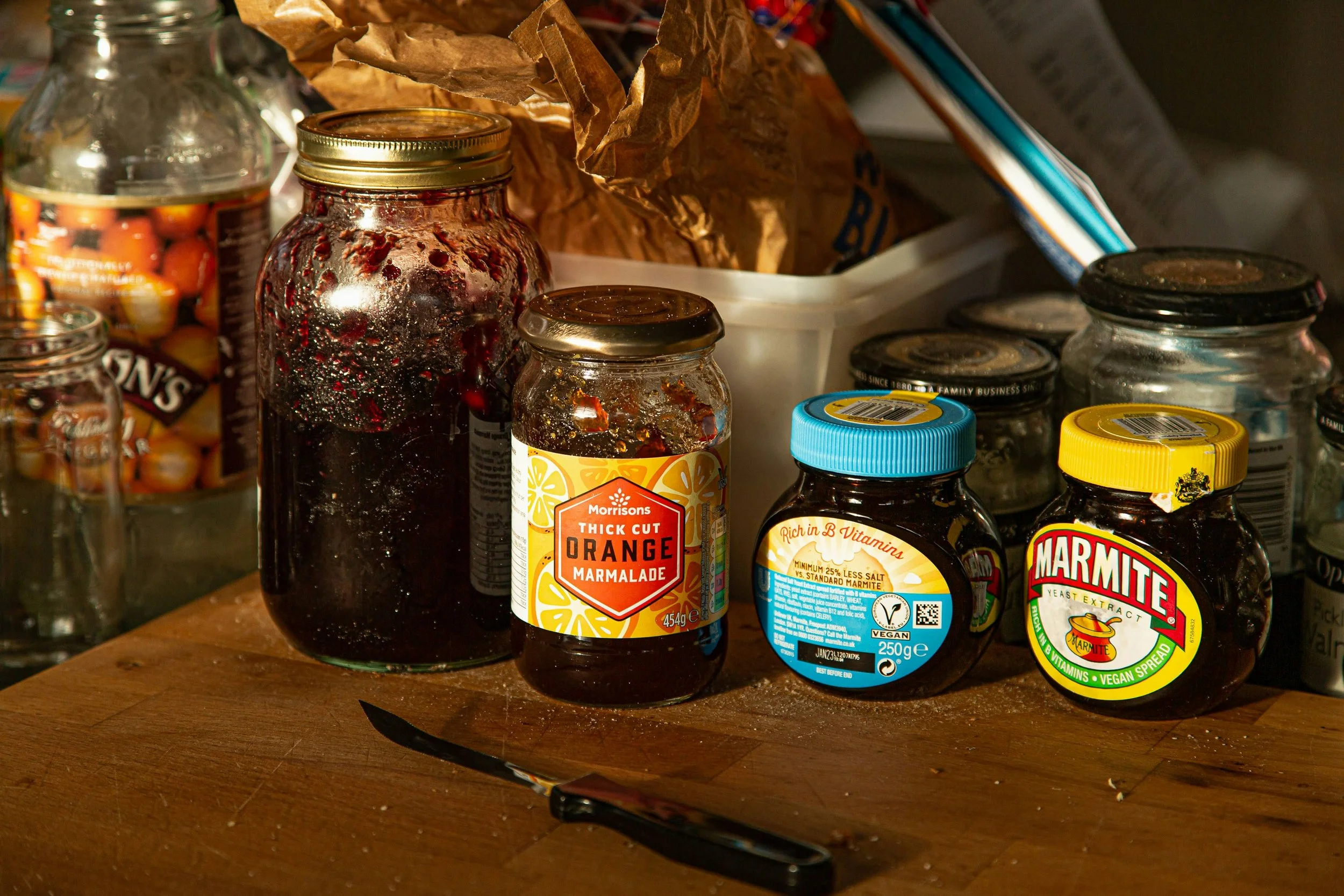
In my Simon in Germany post, I asked: Is Deutsche Bahn Marmite? If that question confused you, this lesson is for you. We’ll look at the idiom, some useful vocabulary from the post, and a grammar point hiding in the text.
Level: B1–B2.
Idiom
Marmite is a dark, sticky, salty spread made from yeast. The British put it on toast, it’s popular with cheese - for example in a cheese sandwich or cheese toastie (a toasted sandwich).
Simon says: I love cheese, but you won’t catch me eating a cheese and Marmite sandwich!
Marmite can also be used to make a hot drink: you put a spoonful of Marmite in a mug of hot water, it dissolves and creates a quick, savoury hot drink.
Simon says: The smell alone makes me feel a bit sick!
Finally, Marmite is a cupboard staple (essential in a kitchen cupboard), because of this, many people use it in cooking.
Marmite is very popular with some. Others think it’s the worst thing they’ve ever tasted. Almost nobody feels “okay” about it.
The brand made Love it or hate it as their slogan. The phrase became so popular that “Marmite” is now an adjective in British English.
If something is Marmite, people either love it or hate it. There’s no middle ground.
That film is a bit Marmite. My sister loved it, I walked out.
He’s a Marmite politician.
Pineapple on pizza is a real Marmite topic.
Simon says: I hate Marmite, but I do love pineapple on pizza!
Notice we often say “a bit Marmite”. It softens the opinion, which is very British - we are not direct in our language use!
And yes, I hate Marmite! But I love Deutsche Bahn - most of the time.
💡 What is an idiom?
An idiom is a phrase whose meaning is different from the meaning of its individual words.
It's raining cats and dogs has nothing to do with animals. It just means it's raining very heavily.
Vocabulary from the post
| Word / phrase | Meaning | From the post |
|---|---|---|
| baffling | very confusing | travelling there by train can be baffling |
| count the pennies | be careful with money | if you're really counting the pennies |
| DFLs | "Down From London", Londoners moving to or visiting the coast | it also brought the DFLs |
| country bumpkin | a person from the countryside (friendly or teasing) | more a country bumpkin, if you will |
| treat myself | do something nice for myself | I treat myself to the ICE |
| surge | move suddenly in large numbers | crowds surge in every direction |
| Surprise, surprise | said ironically when something expected happens | Surprise, surprise, the train was late |
| with seconds to spare | only just in time | caught it with seconds to spare |
| kick someone off | force someone to leave (a train, bus, team) | kicked off a train |
| earn its praise | deserve the good things said about it | the DB app really earns my praise |
Grammar - relative clauses
Relative clauses give more information about a noun. They usually start with who, which, that, whose or where.
Defining relative clauses
They tell us which person or thing. Without them, the sentence doesn't make sense. No commas.
- someone who has been kicked off a train
- a little on-demand bus that takes me to the station
- a Frenchman whose ticket wouldn't scan
- a woman (who/that) I'd noticed on the train – the pronoun is often left out
Non-defining relative clauses
They add extra information. The sentence still works without them. Use commas, and don't use that.
- her father, who came from the area
- Hamburg Hauptbahnhof, which is often called Germany's busiest station
Practice
A. Complete with who, which, whose or where
- I met a man was touring Germany by train.
- We took a taxi to the beach, she swam every year.
- The D-Ticket, costs 63 euros a month, is valid on regional trains.
- The passenger ticket wouldn't scan was French.
B. Defining or non-defining? Add commas if needed.
- Berlin Hauptbahnhof which is very modern is my favourite station.
- The train that I caught turned around.
C. Talk about it
What's Marmite in your country? A food, a TV show, a football team? Tell me in the comments.
Show answers ▾
- who
- where
- which
- whose
- Non-defining: Berlin Hauptbahnhof, which is very modern, is my favourite station.
- Defining, no commas.
Language learning can be really challenging. I know, because I’m a language learner myself. I hope the information and activities were helpful. If you’d like to stay up to date with new posts, sign up below. You can also come and say hi on socials.
Read the original story here
Image credit: Marmite photo by David Griffiths on Unsplash
David Griffiths https://unsplash.com/@itscakefortea
Unsplash https://unsplash.com